

The Confédération Africaine de Football (CAF) continues its efforts to advance women’s football across the continent, with the successful roll-out of its Women’s Football Administrators’ Workshops, organised in collaboration with the six CAF Zonal Unions.
To date, the programme has been implemented within UNIFFAC, WAFU A, UNAF and COSAFA, training a total of 80 participants and strengthening the skills of women’s football officials within the Member Associations.
The initiative continued this week with a WAFU B workshop, scheduled for 26-28 April 2026 in Abuja, Nigeria, bringing together 15 participants from the Member Associations affiliated to this area.
These workshops aim to strengthen leadership, administrative capacity and strategic planning in women’s football, while providing concrete responses to the challenges faced by Member Associations.
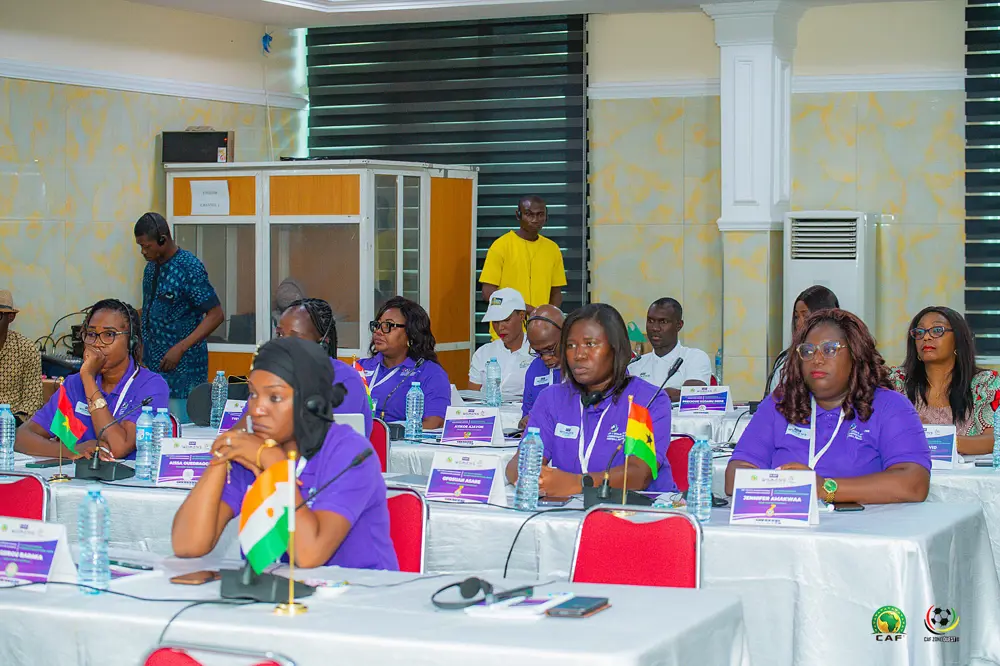
A major focus of the programme is to reduce gaps in access to information, particularly about the support mechanisms available and the means to access it effectively.
Among the key results of this initiative is the development of action plans tailored to each area. Aligned with the specific needs of Member Associations, these plans are real roadmaps to support the development of women’s football. Their implementation is carried out in coordination with CAF and the various Zonal Unions.
“Our ambition with this programme is to build a strong and confident network of administrators and managers committed to the development of women’s football in Africa. Beyond capacity building, it provides a unique platform for sharing experiences, addressing common challenges and learning from each other.
It is a key space for knowledge exchange, but also a strategic tool for CAF to better understand the realities of women’s football within its Member Associations and the different zones.
This allows us to design more relevant, targeted and high-impact programmes, in line with the needs of the field, to accelerate the growth of women’s football on the continent,” said the head of women’s football.
As the programme enters its first year of implementation, CAF expects to see increased momentum, with more Member Associations called upon to adopt and deploy structured programmes, in line with their action plans.
CAF reaffirms its commitment to continuously evolve this initiative, broadening its scope of action and integrating new themes based on feedback from participants.
The workshops will be held every two years in each zone, ensuring sustainable support and measurable progress in the development of women’s football in Africa.
CAF